
SDSN Philippines at the SDSN Global Network Managers Workshop
From November 3 to 6, 2025, representatives from the SDSN Philippines attended an exclusive workshop dedicated for Network Managers in Sunway University, Malaysia.
Anika Pineda – SDSN Philippines Secretariat
11/7/20253 min read
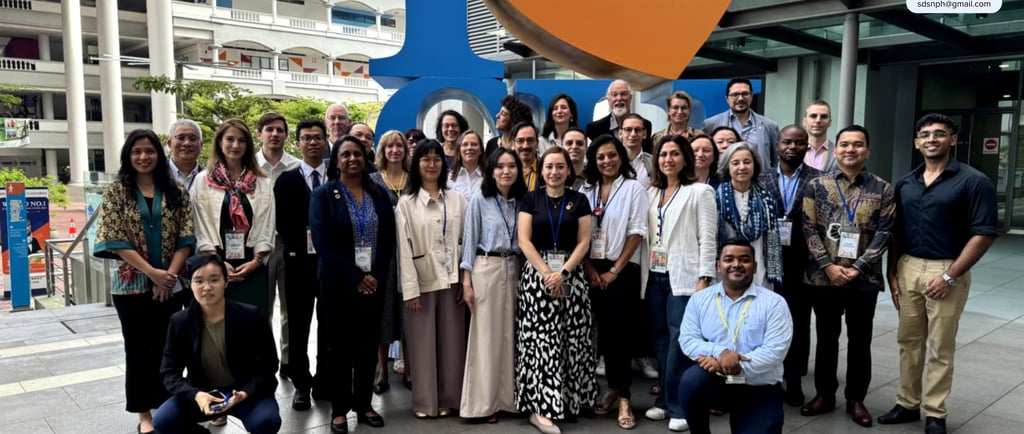
The first face-to-face gathering for SDSN Global Network Managers after the pandemic left attendees with hope for a better tomorrow. Representing SDSN Philippines were Mr. Antonio Carlos Maralit, Country Manager, and Mr. Jonathan Quiambao, Program Officer. Not only were they eager to learn from the experiences of other networks, but were also excited to indulge in the culture of Malaysia, with the workshop being hosted at Sunway University.
The event kicked off with remarks from the leadership of SDSN Global, with special learning sessions led by stellar individuals. Some topics included effective partnership with local governments, zero net campuses and city collaborations, and looking beyond 2030 and the future of the SDGs. Mr. Maralit and Mr. Quiambao was enthusiastic about meeting network leaders from other countries, including those from the United Kingdom, Ireland, Bolivia, Kazakhstan, Benin, Indonesia, Malaysia, and many more.
With the workshop centered on how network managers operate, struggle, and improve, Mr. Maralit and Mr. Quiambao went home with much more than souvenirs. Mr. Maralit found the workshop and its content to be both insightful and overwhelming. He narrated that it started with acknowledging the SDG localization efforts of all the networks. Stories, wins, challenges, and tools were shared without prejudice. Moreover, they looked towards the future, asking themselves what’s next after 2030.
The looming deadline of attaining the SDGs by 2030 is more pressing than ever, with it inching closer. Mr. Maralit shared that outlooks were mixed – ranging from entirely optimistic and motivated, to completely certain that the goals won’t be met by the deadline. However, the collective response is to form a course of action. Suggestions were raised, such as moving the deadline, extending it, or refreshing the 15 year cycle. Mr. Maralit shared it was easy to be overwhelmed with these feelings.
However, he remains steadfast in doing more for sustainable development. “Our network can do so much more,” he says. Other networks (such as Malaysia) were able to break ground at the national level, lobbying for Education for Sustainable Development to be incorporated into the national curriculum. “With De La Salle University as the Network Secretariat, I am looking forward to penetrating different barriers and refocusing our priorities to include these agendas.”
Another main takeaway is the unique power of the arts in localizing sustainable development. “I used to teach at Benilde, a Science and Art class-in-one. I remembered that one of the first advocates for sustainable development in 2013 were people from the Arts.” In short, the approach to sustainable development must be multidisciplinary and transdisciplinary. It is no longer driven by individuals that are purely knowledgeable on technical or natural sciences. At its core, initiatives should be centered on communities and culture.
Mr. Quiambao reflected on the significance of the event. “As part of the Philippine delegation, we were able to contribute by highlighting our recent achievements, including the expansion of our membership through regional roadshows, the growth of key projects such as SDG Localization efforts, and some of the local challenges we encounter,” he shared. He found that the campus tour of Sunway University highlighted how SDGs became a normal, integrated part of operations, and a perfect example of living-sustainability.
His key takeaways include the emerging role of Artificial Intelligence (AI) modelling in development work, particularly in improving data analysis for SDG initiatives. He is also driven to strengthen the youth presence and counterpart of the network in the Philippines. Lastly, he shared that “the discussions during the workshop gave an importance to maintaining a non-partisan approach to the SDGs, where it should remain inclusive, collaborative, and focused on long-term impact regardless of political viewpoint.”
Knowing that “Think Global, Act Local” is executed helps bring a sense of unity amongst people with different backgrounds and cultures but are brought together by the same goal. True to the Filipino spirit, the delegates brought “pasalubong” to share with other networks in the form of SDSN Philippines merchandise (e.g. pins, lanyards, shirts). Half of their luggage was full of it! Their being warm was one way to share the culture of the Philippines, and they are looking forward to possibilities of sharing more of what the Philippines has to offer.
Sustainable Development Solutions Network Philippines
407, Henry Sy Sr. Hall, De La Salle University, Taft Avenue, Malate, Manila
sdsnph@gmail.com
SDSN Philippines is hosted by De La Salle University


De La Salle University - University Sustainability Office