
SDSN Philippines Presents the Luzon Roadshow
On April 17, 2026, SDSN Philippines brought its second national Roadshow to Naga City, through De La Salle University and Ateneo de Naga University, empowering various sectors to realize SDG localization through university-town partnerships.
Anika Pineda – SDSN Philippines Secretariat
5/25/20264 min read
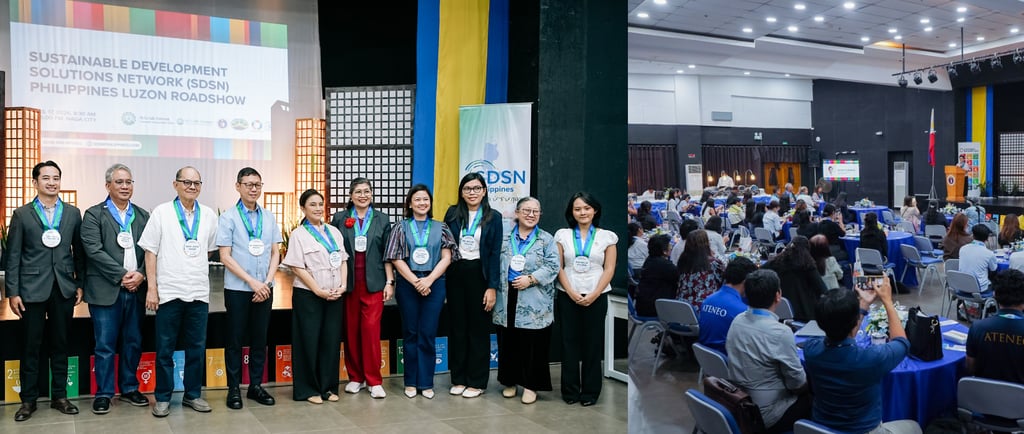
SDSN Philippines kicked off its second Roadshow, the SDSN Philippines Luzon Roadshow 2026: Localizing SDG Catch-Up Plans: University-Town Partnerships for a Sustainable Future. It was co-organized by De La Salle University (DLSU) and Ateneo de Naga University (AdNU), specifically through the University Sustainability Office (DLSU), Jesse M. Robredo Institute of Governance (DLSU), the Institute for Environmental Research and Conservation (AdNU), and Center for Local Governance (AdNU).
Held at Alingal Hall, Ateneo de Naga University, the Luzon Roadshow invited participants and speakers from the region, highlighting effective local solutions that can be replicated. It welcomed over 100 participants, from the academe, local government, civil society, and youth sector.
About the Program
The event was kicked off by Dr. Francisco Magno, Chair of the Leadership Council of SDSN Philippines and Director of the Jesse M. Robredo Institute of Governance. Providing the Welcoming Remarks, Dr. Magno shared that “SDGs cannot be achieved in silos. They demand collective intelligence, shared responsibility, and sustained action.” This echoes his call for the academe and local government to formally work together in localizing SDGs. This attitude of multi-sectoral collaboration resonated throughout the duration of the event.
Mayor Leni Robredo, 14th Vice President of the Philippines and the current Mayor of Naga City, provided the Keynote Speech. “We lack so much, as far as capacity is concerned. But we are open to collaborating with so many sectors.” This was evident in her testimonies regarding collaborations with various academic and civil society organizations in Naga and Bicol. In championing the SDGs, she placed an emphasis on leadership, capacity for long-term execution, and accountability. She strongly stated that “good governance requires constant vigilance and commitment.”
The inspiring morning continued with the Panel 1: Knowledge Partnerships for SDGs. It focused on the role of the academe and national agencies in bolstering access and innovation to knowledge on sustainable development. Dr. Fay Lea Patria M. Lauraya, President of the University of Nueva Caceras, Dr. Digna P. Alba, Vice President for Higher Education of AdNU, Professor Eddie M. Nuque, Visiting Fellow from the DLSU Jesse M. Robredo Institute of Governance, Professor Kalayaan C. Triunfante, World University Ranking Coordinator, Office of the President, of Bicol University, and Ms. Richel A. Callos, Supervising Economic Development Specialist, Department of Economy, Planning, and Development (DEPDev) – Region 5 were the panelists, with Dr. Malu Barcillano, Director of the AdNU Center for Local Governance and Dean of Graduate Studies serving as Panel Moderator. One of the discussions' foci was on measuring outcomes beyond publications and to include policy influence and community benefits. Moreover, addressing how innovations can be scaled sustainably through data-driven evaluation, LGU capacity-building, and long-term partnerships.
The panelists for Panel 2: Collaborating for SDG Solutions were Mayor Edelson Marfil, Mayor of Libmanan, Camarines Sur, Atty. Sheina Onrubia-Dela Cruz, Provincial Board Member for Albay, Ms. Cyrene Dominique Cervas, Deputy Project Manager for Safe and Sound Cities Naga, Ms. Rafaella Justine Marie Villena, National Coordinator for SDSN Youth Philippines, and Mr. Warren Dollente, Municipal Planning And Development Coordinator of Libmanan City. It was moderated by Mr. Ramil Marianito, Director of the Philippine Information Agency – Region 5. From the local-level perspective, pressing challenges such as poverty, resettlement, youth development, and accessibility require context-specific, action-oriented solutions rather than pure discussion. Genuine co-creation is essential with stronger inclusion of marginalized groups and youth in decision-making. In conclusion, what’s being discussed at a seminar level must be reflected at the street level. Each panel featured an open forum where audience members had the opportunity to raise their questions.
Students from AdNU then displayed an energetic cultural performance, showcasing a dance from Bantigue, Masbate City, called Lapay Bantigue. It depicts the thousands of “lapay” or seagulls that fly over the shores of Bantigue Village. Newly joined members of SDSN Philippines, specifically Tarlac Agricultural University, were awarded their Certificates of Membership as well.
Motivated by the fruitful discussions in the morning, the afternoon session provided room for Luzon Roadshow participants to gather in smaller group discussions. As there were four break-out sessions, the focus areas were 1) Local Needs – addressing the most urgent SDG-related challenges, 2) Knowledge Partnerships – alignment of universities’ research responding to local relations, 3) Co-Creation and Inclusive Collaboration – multi-sectoral partnerships moving beyond consultation, and 4) Scaling and Sustaining Impact – strategies for long-term development. Each group was given a Solutions Tree framework, where they identified the problems (ROOTS), hindrances (TRUNK), solutions (BRANCHES), and outcomes (LEAVES), of each focus area. Read the discourse of the smaller group discussions here.
The groups then had the opportunity to report their completed framework with the rest of the audience. Each group provided ample solutions for each focus area, even providing personal testimonies to solutions already enacted/being implemented.
To synthesize the group reports, Mr. Antonio Carlos Maralit, Country Manager of SDSN Philippines took to the stage. He first shared his motivations for pursuing sustainable development, and was energized by the shared vigor for the SDGs. He took the opportunity to view sustainable development on a macro-level, sharing the most recent results of the World Happiness Report. He synthesized that the realization of the SDGs at the local level provides solutions to the most basic needs of people, leading to a realized happiness. Mr. Gautham Narayan, Manager of the Asia Pacific Networks Programs of SDSN then provided the Closing Remarks. He shared that starting at the local level is key to sustainable and inclusive development that will eventually lead to national progress.



Sustainable Development Solutions Network Philippines
407, Henry Sy Sr. Hall, De La Salle University, Taft Avenue, Malate, Manila
sdsnph@gmail.com
SDSN Philippines is hosted by De La Salle University


De La Salle University - University Sustainability Office